
In Regards to Tortoises
Giants in the City (A Cautionary Tale)
Walk into just about any reptile expo or pet store in the northeast and you can find a little half dollar-sized tortoise for sale for around sixty dollars. You think, what the heck? I have a little heat dome and a ten-gallon aquarium from when the kids got bored of their county fair goldfish. Why not? Surely this little shelled critter toddling around will be easier to deal with than the weekly water changes the goldfish needed. So you open your wallet and extract a few bills and the clerk smiles at you and unlocks a tiny glass door.
What you don’t know is that you just made a commitment, no matter how brief, to an ancient (and long-lived) giant African animal who will outweigh you before your kids finish high school.
You do everything right. Your grocery bills increase from all the produce you feed daily. Your garage is filled with outgrown pens and enclosures, which you can resell for a little bit of cash. ‘Like new,’ your ad says, because this one lasted for eight months. You have a closet full of basking bulbs and still others capable of producing ultraviolet light because tortoises need it to process the calcium in their diet for their shells to stay domed. This is more work and more expensive than you expected, but things are okay.
Last summer’s family project was building an outdoor space for your giant African family member to enjoy the occasional warm day outside, even though the northeast has precious few of those. It took a long time to build and fills up most of the area the kids used to use for playing ball, but that’s okay. Your youngest, who liked to watch tv after school with the tortoise on his lap, now won’t go near the pen, reporting that the ‘turtle smells bad’ because his poo is bigger than the dog’s, and when you aren’t home to notice it immediately, he walks through it. But it’s okay. You didn’t get this pet to ‘teach your kid responsibility,’ you knew that you and your spouse would be doing the majority of the work.
Like last winter, when you had to find an exotic vet to treat a respiratory infection your tortoise caught because the overnight heating bulb in his house burned out at some point and the basement where you now keep him got too cold. That was your mistake, and the few thousand dollars you spent on vet bills and injections to help him recover was just ‘idiot tax.’ You won’t let that happen again.
But then, on some balmy August day when the kids are doing travel soccer and you’re gone all day to ferry them to and from their away games, your living boulder starts to dig. He makes an unsightly hole in the lawn and hides in it to escape the midday sun. A natural behavior, you know, just too bad he doesn’t use the kids’ old sandbox that you filled up for him. Then he makes another, and another, holes so big he disappears inside of them and can’t be seen when you get down on your knees to look inside. Now that he’s outside, the smell isn’t as bad, and you don’t have to pick up his poop as often, although your weekly grocery list still includes loads of leafy greens because the lawn doesn’t stand a chance against his appetite. You wish the summer could last forever, and think to yourself, this would be a lot easier if I lived somewhere warmer.
A few weeks later, you’re pulling into the driveway two hours past sundown with a pair of grumpy kids in the car, you notice something is off. At first, you can’t tell what it is. There’s a sound. A sputtering, hissing sound. And it’s coming from somewhere you can’t see, but is close by. Your yard. You drop the half crumpled bag of fast food in your hand and take the side door at a sprint. Water floods the entry way, more two inches deep stretching down the hall and into the kitchen, coming from a source you can’t see. Did the intake to the sink or dishwasher bust inside the wall? Where is the leak coming from? You remember the tortoise, somewhere in the yard.
You change direction, taking in the extent of the damage as the rest of the family flows through the front door, noisy and clamoring in surprise at what they’re seeing. Once in the backyard you understand. Muddy turbulent water flows from the back of the house, seeming to bubble from the soil itself. It takes several phone calls and several hours to get the right people on the phone to stop the deluge, all the while, a swimming pool’s worth of water is surging ever forward, its path of destruction unstoppable.
The next day, when the insurance inspector comes to assess the damage, you discover the truth. In his digging, your tortoise managed to find the vulnerable seam where the town’s main water line joins to the much smaller pipe entering the foundation of your house. The insurance agent shakes his head. Your homeowner’s insurance won’t cover the cost of the excavation needed to make the repair, nor what the town is going to charge you in damages. When you ask, ‘How much are we talking? Five thousand, ten thousand dollars?’ The number he tells you takes your breath away.
Does this sound like a horror story? To Stray Pride this kind of tale is all too familiar. ‘We didn’t know what his care would actually involve.’ ‘We didn’t know how expensive/destructive/messy he would be.’ We get it. An animal likely to outlive you (or even your kids) is a serious commitment, the likes of which many can’t even conceptualize until they are living the reality of it.
Sulcatas are the most abandoned captive-bred reptile; the current rate of rehoming is estimated to hover around 90%. Shelters are overwhelmed, and most rescues refuse to accept them, moving instead to long waitlists of owners ready to surrender as soon as a willing new owner appears. A disturbing trend of releasing pets into wild areas and hoping they end up in the hands of some Good Samaritan is on the rise, leading to the discovery of empty shells found tucked up under trees in areas where the temperatures drop too low for an animal from sub-Saharan Africa.
Do we think sulcatas and other giant tortoises shouldn’t be in human care? Depends on the day you ask, to be honest. Some of the most compassionate animal people I know have had to close their doors to these unwanted giants, due to the amount seeking shelter and their expansive care requirements. But one thing rings true— if you want to adopt one of these magnificent, powerful destructive eating machines, better you go into it both PREPARED and EDUCATED.
And please, if you have to have one, don’t impulse buy a baby. Adopt one of the thousands in the country currently looking for a home.
-Written October 2026, Laura Pelletier, Adoption Coordinator Stray Pride!! Animal Rescue
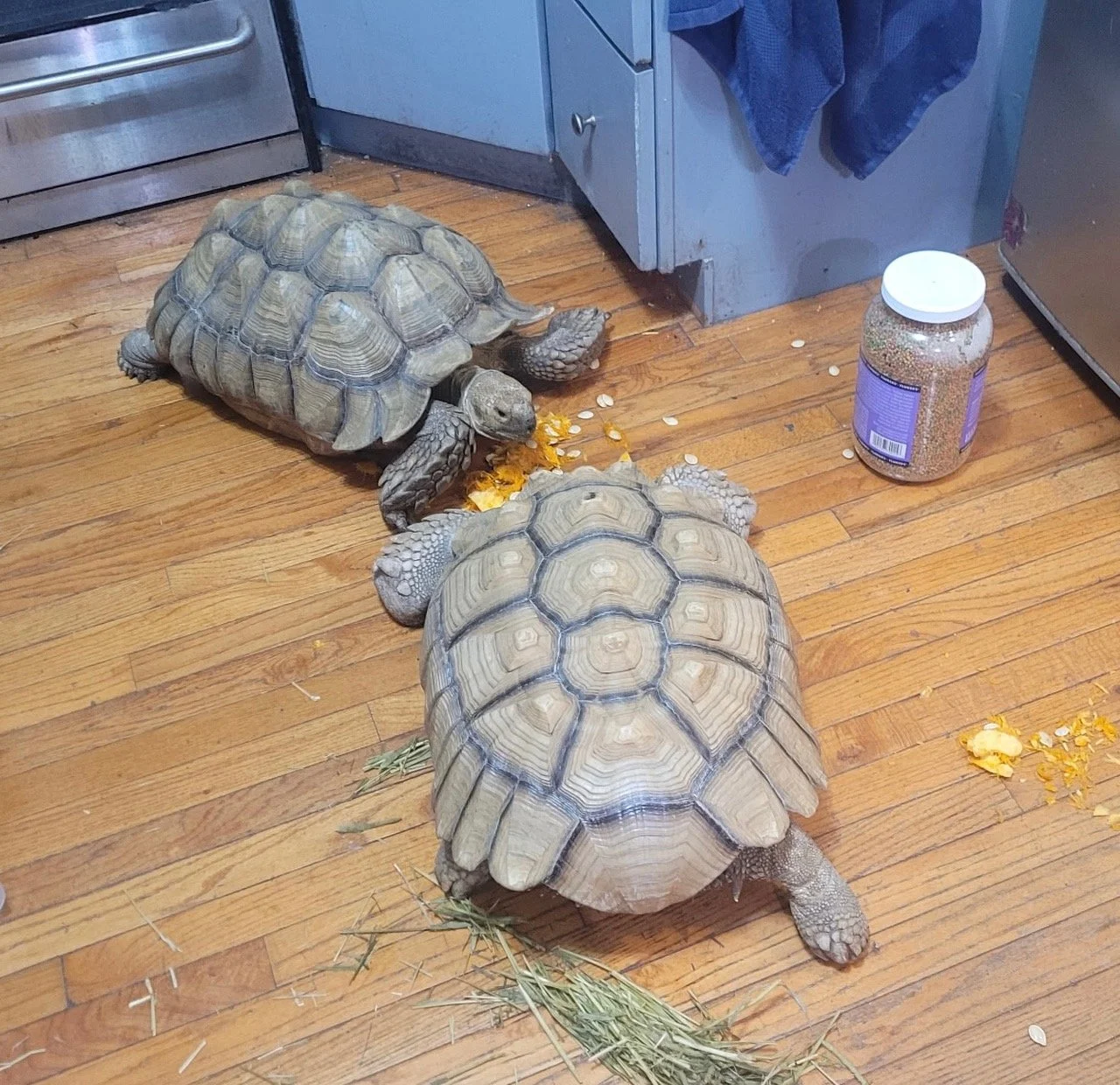
100 pounds of Tortoise in a 750 sq ft NYC Apartment
A pair of surrendered 50 pound Sulcata Tortoises, both males around 15 years old, peacefully eating some pumpkin. It’s a minor miracle that these two get along peacefully as both have spent their lives without meeting another tortoise. Males of reproductive age often fight, using a pair of spear-like gular scutes projecting outward under their necks to spar, often separating soft tissue from the bone of their shells, resulting in severe injury, infection, an occasionally death.
Just because two tortoises live together well right now doesn’t mean they always will. Males especially may turn aggressive at anytime, often over reproductive seasonal changes like breeding season and territorial disputes.
Even females have been known to engage in mounting, ramming, flipping and other aggressive behaviors from time to time. There’s no knowing what goes on in the mind of a tortoise!
Surrendered due to divorce, loss of indoor enclosure space or a yard due to moving, and the advanced age of an owner who could no longer care for them, tortoises like these are housed in less-than-ideal temporary foster homes until long term placements can be found. Stray Pride!! Animal Rescue & Rehome vets all potential new owners in a effort to find the best long term stewards of these ancient and demanding animals, asking that should anyone adopting find themselves unable or unwilling to care for their animal, that they offer Stray Pride!! Animal Rescue the first opportunity to rehome— judgement free.